
.png)
I built a portfolio of companies that have generated $280M in combined revenue over the past 6 years.
This wasn't a one-off success. This revenue came from 15+ interconnected businesses, built back to back, each one feeding into the next.
In this case study, I break down how we systematized growing companies to an operational science through data… reducing the elements of luck and risk to consistently surpass-able factors.
Every business hits growth bottlenecks… which is obvious.
What's not always obvious is how to solve them.
Whether it's acquisition channels, fulfillment speed, quality of goods and services, or customer support, the same core scaling problems appear in every industry. We've built businesses across 4+ different industries and encountered the same fundamental constraints in each one.
What each of these problems share in common is that the problems or solutions lay in plain sight if you know where to look - the data. The problem isn't just that businesses lack data. Even when they have data, they typically lack the knowledge of what to do with it to break through.
.png)
Overcoming Business Scaling Bottlenecks
Success is fundamentally a function of product-market-fit strength.
Most businesses either reach a “good enough” fit, or fail to reach basic profitability altogether and fail.
Very few actually achieve a level of market alignment that yields the potential for market leading growth.
The difference between perfectly aligned product market fit and half aligned can be:
We saw this at scale first hand in E-Commerce:
95% of these business scenarios lead to the same final result: shutting down shop with nothing to show but losses.
… really, 95% of products would fail. Having a successful business just comes down to luck… Unless… There was a strategy to use these odds in your favor?
We discovered that aggressive validation before building was the difference between “maybe this works” and predictable, repeatable wins.
It’s the same reason venture capital always wins: they don’t need every bet to hit. They just need a system that:
That one principle was the 80:20 that determined whether a project stalled out… or ripped from $0 → $1M fast.
Most founders do the opposite. They make the failure expensive first, then call it “learning.”
We made the learning cheap first. Then we earned the right to scale.
Below I’ll walk you through our proprietary approach to predictably finding product market fit at scale within E-Commerce, the largest industry in the world. This formula became the foundation to all of my future success, spanning through software businesses to services businesses. It works exactly the same way in whichever industry it is applied.
Stage One: Initial Validation
If yes, move forward. If no, kill it immediately.
Stage Two: Proven Validation
Once a product passed initial testing:
When the numbers worked, it became a money multiplier. We'd confidently order inventory and pour money into ads as fast as we could because every dollar returned three.
Only 5% of products passed this test. But that's the point… we filtered out 95% of losers before investing real money.
Each failed test cost $200-500 instead of $10,000+ on inventory nobody wanted. By the time we actually launched, we were only launching validated winners.
Our actual launch success rate? 90%+. The testing pipeline ensured it.
In AI services, the initial phase 1 pass rate is dramatically higher - upwards of 50%. That's what makes this entire industry a winner like nothing we have ever seen before!
Here are a few of the many e-com stores we launched. We made millions of dollars with these.



This validation framework became a core lesson that materially impacted every business I built from that point forward. Whether it was e-commerce, services, software, or anything else, the principle remained: validate demand before scaling operations.
I applied this process for years and made millions. Then Apple’s iOS 14.5 update killed Meta's own AI tracking capabilities.
Instead of forcing a high friction model, I took the same validation principles and started applying them to a completely different industries.
You can make $500K/year and be completely enslaved to your business. If you're still working 14-hour days, you're just building yourself a more stressful job.
Systematize data management and employee processes so you work ON the business, not IN it
I've seen businesses collapse because they had no visibility into what was actually happening:
Without data, you're guessing. And guessing at scale is catastrophic.
We solved this by treating the business like software. Track the right data, and you can optimize it like code. Each business’s events were broken down to data patterns with scenarios defined in extreme detail - “if” this happens, then follow that SOP / “and” if that happens, then follow this SOP too.
We defined the core metrics that determined how everyone needed to handle any event that would arise successfully, from initial hiring touchpoint through to promotion, and firing when standards weren't met.
At peak employee count: 130 employees. $3 million per month in revenue. We became known as one of the highest-end service providers in the space achieving boutique results at scale.
The math: If you need 10 A-players and only 1% qualify, you need to process 1,000 applicants.
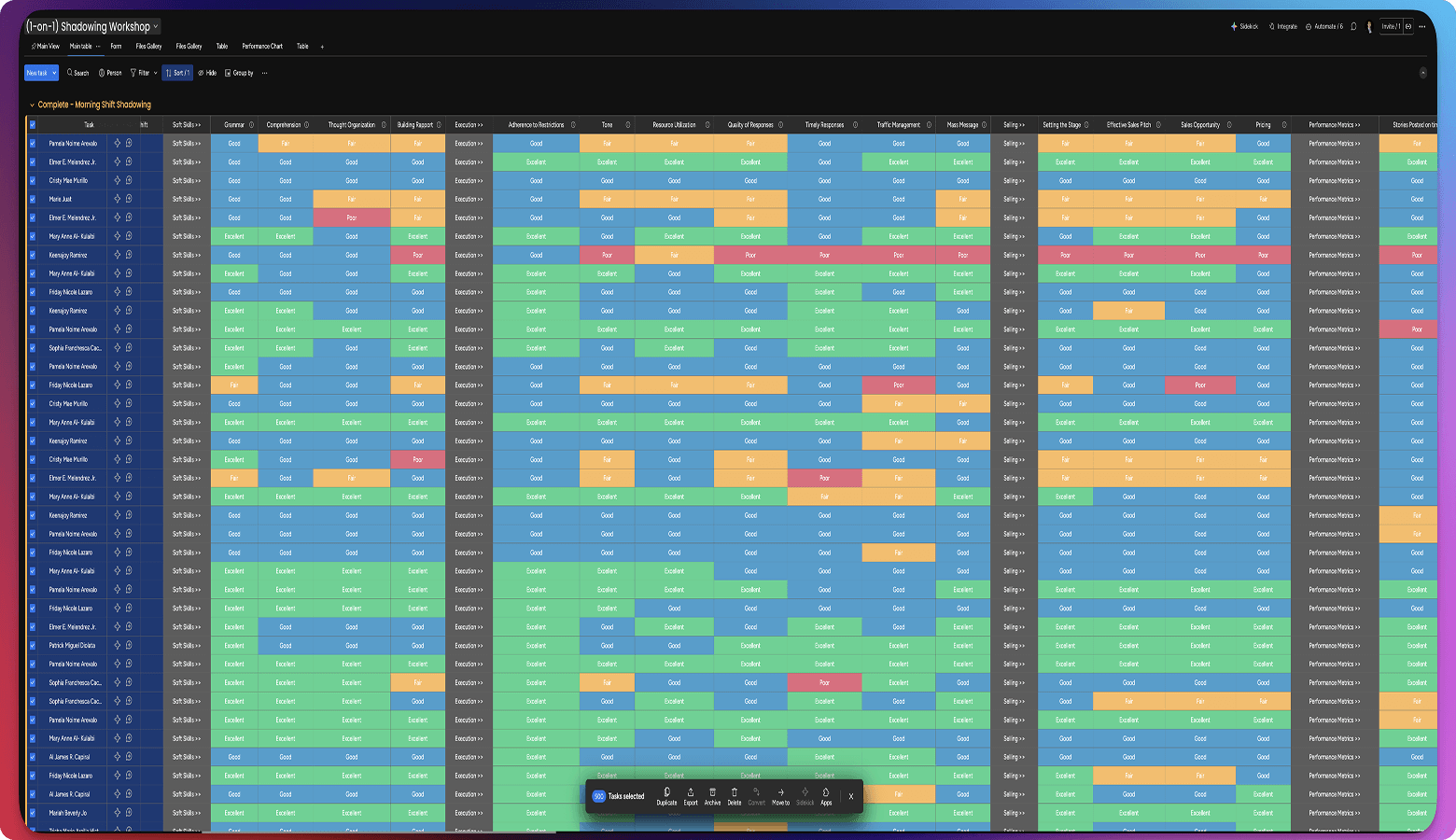
Every employee tracked across their entire journey:
Hiring Phase:
Onboarding Phase:
The entire hiring and onboarding process is 100% automated and managed by AI, up until in Person Shadowing Training, which would only occur once the candidate’s aptitude was autonomously validated, autonomously trained on a common knowledge foundation, and ready to be personally trained by a senior employee to fine tune details.
Active Phase:
Career Progression:
This is running a business like software. You have logs, metrics, and dashboards.
Most businesses operate blind. We knew everything.
What we discovered is that solving problems and gaining experience in one field naturally leads to adjacent market opportunities - stacking up your competitive advantage
Either the knowledge, systems, and tech you've built can be applied directly to a new field, or there's a close enough match that expanding becomes low-hanging fruit.
We penetrated the creator economy and saw the landscape: operationally undeveloped, unprofessional, agencies running on spreadsheets, gut feelings, and chaos.
In this industry, we quickly outgrew the under developed off the shelf softwares needed to run the business - so we launched software businesses over the years to aid our own growth:
Other agencies manage their businesses using our tools. Because we own them, we see how those agencies perform.
When an agency is under performing, we can see it in their performance data.
We reach out and offer managed services… already knowing exactly how their averages compare to ours and what results we would drive.
In our B2B service, we would only work on top 1% accounts. Instead of turning down the other 99% of our clients accounts we would not fully manage, we would get them on our software which would help them grow and drive the software’s growth. All while monitoring performance until they became qualified, so we knew when unqualified became qualified.
Agency feeds software. Software feeds agency. That's a flywheel.
We even started licensing our entire end to end business infrastructure and exiting our of our contracts to venture capital. Deals starting at $400K. Investors buy a small piece of our business, fully staffed, perfectly systematized, with predictable cashflow and growth. They step in as a true CEO from Day 1, thus skipping the sleepless nights and painful failures.
Single-product businesses are fragile. One market shift can destroy you (iOS 14.5 did this to E-Commerce). Interconnected businesses that feed each other create resilience AND compounding growth.
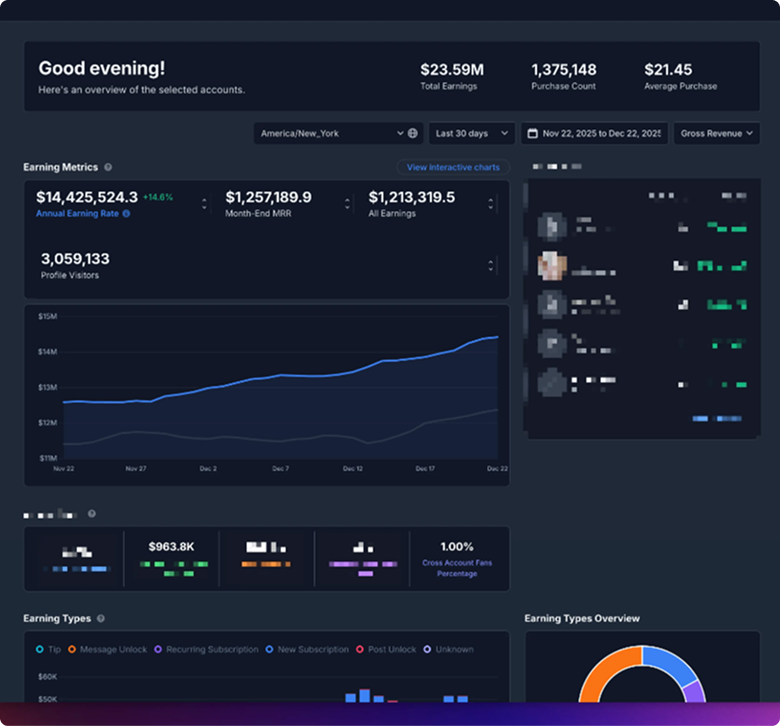
Some revenue from our own 130 team company + a view of our CRM analytics tool that also brings in $1.2M monthly.
Over the years, the bottlenecks we were solving evolved.
It started with basic operational constraints:
But as we built more systems, we recognized a shift. The competitive edge was no longer just about doing things faster or cheaper… it was about introducing and developing technology to outcompete businesses using AI for efficiency gains.
Which meant our process and capabilities to solve bottlenecks kept developing:
We went from manual data enrichment (the same work that companies like Clay now automate) to AI-powered hiring systems, performance tracking, and operational automation.
The bottlenecks became more sophisticated. So did our solutions.It started with basic operational constraints:
When you've validated markets, systematized operations, and built flywheels across multiple industries, growth becomes closer to an inevitable system than something of chance.
You recognize the patterns. Once you see them, you can't unsee them.
This didn't just lead to building our own companies. People started asking us to help them build theirs. Friends of friends. Referrals. Larger and larger businesses who knew we were the right team to take them to the next level. People who saw our results and wanted the same.
We realized: if we could package everything we'd learned (the validation framework, the systematization playbook, the AI-powered operations) we could help businesses at scale. The perfect opportunity became clear when we saw the critically low supply and high demand for AI Service Firms, followed by our own wild success in the industry. It is a combination of everything we love most about business in one perfect package of an industry.
This became the basis of the AI operational fulfillment system that is AI Scaling.
Built on the same principles that generated $280M across our portfolio.
We're not just an agency. We're the infrastructure layer.
The critical insight most people miss: you can't automate what isn't tracked digitally. 75% of businesses under $2M have no work management system whatsoever.
Most AI agencies build half-baked one-off solutions. Client works with another agency, another half-baked solution. Over time: an accumulating mess of disconnected automations. Every job requires reinvesting the wheel while client success is sub par at best.
We spent 8 months building the end all be all solution - a standardized data and work management foundation that is critical for uninterrupted success in the AI implementation space that is exploding in growth everywhere around us. We built it around the universal building blocks every business needs control over to grow: employees, projects, tasks, clients, deliverables.
It is more complex than most Fortune 500 systems. Simpler to implement than Notion or ClickUp.
Because it's standardized, our automations are plug-and-play. This is the moat. Once this is achieved, our AI agents modularly plug and play into the system seamlessly, and customization is as simple as providing information or asking questions.
Stage 1
Stage 2
Stage 3
Stage 4
Product-market fit through validation
Systematize operations with data
Create flywheels from adjacent opportunities
Package systems for others
Fail fast and cheap until you find the winner
Build it like software. Work ON the business, not IN it
Use competitive advantages to multiply effort
Growth becomes an inevitable system, not chance
Not everything worked. We launched ImagineX… it flopped. But our core analytics tool became top 3 in the market, and our messaging platform is rapidly growing.
Winners pay for losers 10X over.
When you systematize and free up your time, you have bandwidth to try multiple things. When you evolve from solving basic bottlenecks to AI-powered systems, you can help other businesses do the same.
That's how $280M in revenue across 15+ companies became the foundation for an AI services firm.
— Daniel, Founder of AI Scaling


I built a portfolio of companies that have generated $280M in combined revenue over the past 6 years.
This wasn't a one-off success. This revenue came from 15+ interconnected businesses, built back to back, each one feeding into the next.
In this case study, I break down how we systematized growing companies to an operational science through data… reducing the elements of luck and risk to consistently surpass-able factors.
Every business hits growth bottlenecks… which is obvious.
What's not always obvious is how to solve them.
Whether it's acquisition channels, fulfillment speed, quality of goods and services, or customer support, the same core scaling problems appear in every industry. We've built businesses across 4+ different industries and encountered the same fundamental constraints in each one.
What each of these problems share in common is that the problems or solutions lay in plain sight if you know where to look - the data. The problem isn't just that businesses lack data. Even when they have data, they typically lack the knowledge of what to do with it to break through.
Overcoming Business Scaling Bottlenecks
Success is fundamentally a function of product-market-fit strength.
Most businesses either reach a “good enough” fit, or fail to reach basic profitability altogether and fail.
Very few actually achieve a level of market alignment that yields the potential for market leading growth.
The difference between perfectly aligned product market fit and half aligned can be:
We saw this at scale first hand in E-Commerce:
95% of these business scenarios lead to the same final result: shutting down shop with nothing to show but losses.
… really, 95% of products would fail. Having a successful business just comes down to luck… Unless… There was a strategy to use these odds in your favor?
We discovered that aggressive validation before building was the difference between “maybe this works” and predictable, repeatable wins.
It’s the same reason venture capital always wins: they don’t need every bet to hit. They just need a system that:
That one principle was the 80:20 that determined whether a project stalled out… or ripped from $0 → $1M fast.
Most founders do the opposite. They make the failure expensive first, then call it “learning.”
We made the learning cheap first. Then we earned the right to scale.
Below I’ll walk you through our proprietary approach to predictably finding product market fit at scale within E-Commerce, the largest industry in the world. This formula became the foundation to all of my future success, spanning through software businesses to services businesses. It works exactly the same way in whichever industry it is applied.
Stage One: Initial Validation
If yes, move forward. If no, kill it immediately.
Stage Two: Proven Validation
Once a product passed initial testing:
When the numbers worked, it became a money multiplier. We'd confidently order inventory and pour money into ads as fast as we could because every dollar returned three.
Only 5% of products passed this test. But that's the point… we filtered out 95% of losers before investing real money.
Each failed test cost $200-500 instead of $10,000+ on inventory nobody wanted. By the time we actually launched, we were only launching validated winners.
Our actual launch success rate? 90%+. The testing pipeline ensured it.
In AI services, the initial phase 1 pass rate is dramatically higher - upwards of 50%. That's what makes this entire industry a winner like nothing we have ever seen before!
Here are a few of the many e-com stores we launched. We made millions of dollars with these.
This validation framework became a core lesson that materially impacted every business I built from that point forward. Whether it was e-commerce, services, software, or anything else, the principle remained: validate demand before scaling operations.
I applied this process for years and made millions. Then Apple’s iOS 14.5 update killed Meta's own AI tracking capabilities.
Instead of forcing a high friction model, I took the same validation principles and started applying them to a completely different industries.
You can make $500K/year and be completely enslaved to your business. If you're still working 14-hour days, you're just building yourself a more stressful job.
Systematize data management and employee processes so you work ON the business, not IN it
I've seen businesses collapse because they had no visibility into what was actually happening:
Without data, you're guessing. And guessing at scale is catastrophic.
We solved this by treating the business like software. Track the right data, and you can optimize it like code. Each business’s events were broken down to data patterns with scenarios defined in extreme detail - “if” this happens, then follow that SOP / “and” if that happens, then follow this SOP too.
We defined the core metrics that determined how everyone needed to handle any event that would arise successfully, from initial hiring touchpoint through to promotion, and firing when standards weren't met.
At peak employee count: 130 employees. $3 million per month in revenue. We became known as one of the highest-end service providers in the space achieving boutique results at scale.
The math: If you need 10 A-players and only 1% qualify, you need to process 1,000 applicants.
Every employee tracked across their entire journey:
Hiring Phase:
Onboarding Phase:
The entire hiring and onboarding process is 100% automated and managed by AI, up until in Person Shadowing Training, which would only occur once the candidate’s aptitude was autonomously validated, autonomously trained on a common knowledge foundation, and ready to be personally trained by a senior employee to fine tune details.
Active Phase:
Career Progression:
This is running a business like software. You have logs, metrics, and dashboards.
Most businesses operate blind. We knew everything.
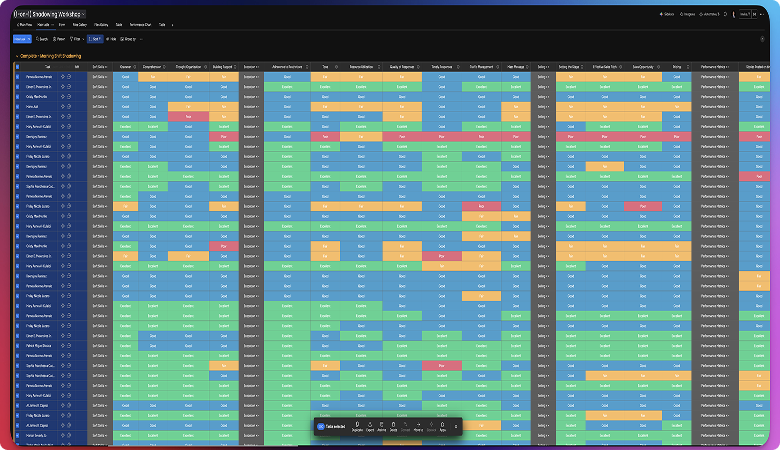
What we discovered is that solving problems and gaining experience in one field naturally leads to adjacent market opportunities - stacking up your competitive advantage
Either the knowledge, systems, and tech you've built can be applied directly to a new field, or there's a close enough match that expanding becomes low-hanging fruit.
We penetrated the creator economy and saw the landscape: operationally undeveloped, unprofessional, agencies running on spreadsheets, gut feelings, and chaos.
In this industry, we quickly outgrew the under developed off the shelf softwares needed to run the business - so we launched software businesses over the years to aid our own growth:
Other agencies manage their businesses using our tools. Because we own them, we see how those agencies perform.
When an agency is under performing, we can see it in their performance data.
We reach out and offer managed services… already knowing exactly how their averages compare to ours and what results we would drive.
In our B2B service, we would only work on top 1% accounts. Instead of turning down the other 99% of our clients accounts we would not fully manage, we would get them on our software which would help them grow and drive the software’s growth. All while monitoring performance until they became qualified, so we knew when unqualified became qualified.
Agency feeds software. Software feeds agency. That's a flywheel.
We even started licensing our entire end to end business infrastructure and exiting our of our contracts to venture capital. Deals starting at $400K. Investors buy a small piece of our business, fully staffed, perfectly systematized, with predictable cashflow and growth. They step in as a true CEO from Day 1, thus skipping the sleepless nights and painful failures.
Single-product businesses are fragile. One market shift can destroy you (iOS 14.5 did this to E-Commerce). Interconnected businesses that feed each other create resilience AND compounding growth.
Some revenue from our own 130 team company + a view of our CRM analytics tool that also brings in $1.2M monthly.
Over the years, the bottlenecks we were solving evolved.
It started with basic operational constraints:
But as we built more systems, we recognized a shift. The competitive edge was no longer just about doing things faster or cheaper… it was about introducing and developing technology to outcompete businesses using AI for efficiency gains.
Which meant our process and capabilities to solve bottlenecks kept developing:
We went from manual data enrichment (the same work that companies like Clay now automate) to AI-powered hiring systems, performance tracking, and operational automation.
The bottlenecks became more sophisticated. So did our solutions.It started with basic operational constraints:
When you've validated markets, systematized operations, and built flywheels across multiple industries, growth becomes closer to an inevitable system than something of chance.
You recognize the patterns. Once you see them, you can't unsee them.
This didn't just lead to building our own companies. People started asking us to help them build theirs. Friends of friends. Referrals. Larger and larger businesses who knew we were the right team to take them to the next level. People who saw our results and wanted the same.
We realized: if we could package everything we'd learned (the validation framework, the systematization playbook, the AI-powered operations) we could help businesses at scale. The perfect opportunity became clear when we saw the critically low supply and high demand for AI Service Firms, followed by our own wild success in the industry. It is a combination of everything we love most about business in one perfect package of an industry.
This became the basis of the AI operational fulfillment system that is AI Scaling.
Built on the same principles that generated $280M across our portfolio.
We're not just an agency. We're the infrastructure layer.
The critical insight most people miss: you can't automate what isn't tracked digitally. 75% of businesses under $2M have no work management system whatsoever.
Most AI agencies build half-baked one-off solutions. Client works with another agency, another half-baked solution. Over time: an accumulating mess of disconnected automations. Every job requires reinvesting the wheel while client success is sub par at best.
We spent 8 months building the end all be all solution - a standardized data and work management foundation that is critical for uninterrupted success in the AI implementation space that is exploding in growth everywhere around us. We built it around the universal building blocks every business needs control over to grow: employees, projects, tasks, clients, deliverables.
It is more complex than most Fortune 500 systems. Simpler to implement than Notion or ClickUp.
Because it's standardized, our automations are plug-and-play. This is the moat. Once this is achieved, our AI agents modularly plug and play into the system seamlessly, and customization is as simple as providing information or asking questions.
Stage 1
Stage 2
Stage 3
Stage 4
Product-market fit through validation
Systematize operations with data
Create flywheels from adjacent opportunities
Package systems for others
Fail fast and cheap until you find the winner
Build it like software. Work ON the business, not IN it
Use competitive advantages to multiply effort
Growth becomes an inevitable system, not chance
Not everything worked. We launched ImagineX… it flopped. But our core analytics tool became top 3 in the market, and our messaging platform is rapidly growing.
Winners pay for losers 10X over.
When you systematize and free up your time, you have bandwidth to try multiple things. When you evolve from solving basic bottlenecks to AI-powered systems, you can help other businesses do the same.
That's how $280M in revenue across 15+ companies became the foundation for an AI services firm.
— Daniel, Founder of AI Scaling
We capitalized on this shift to build a 7-figure AI Service Firm without technical skills, coding, or hiring developers.
Limited Spot, Book A Call NowEarnings Disclaimer: Individual results may vary. The testimonials and case studies presented are from actual AI Service Firm partners and represent their personal experiences, but should not be considered as average or typical results. These testimonials showcase what our most successful and motivated partners have achieved and are not guaranteed outcomes for all participants. Financial success with AI Service Firms depends on many factors including but not limited to market conditions, client acquisition efforts, implementation quality, business management skills, and local competition. Each business opportunity is unique, and your results will vary based on your personal commitment, experience, expertise, and level of desire. As an AI Service Firm owner, you assume full responsibility for your business decisions and actions.
You should perform your own due diligence and use your best judgment before investing in our program. By engaging with our website, marketing materials, or participating in our program, you acknowledge that you are fully responsible for your business investments and any outcomes that may result. AI Scaling makes no guarantee regarding income or earnings. We do not offer "get rich quick" programs. Any financial numbers referenced on our website or in our materials are illustrative examples only and should not be considered as promises or guarantees of earnings. This site is independently owned and operated by AI Scaling and is not affiliated with, endorsed by, or sponsored by any social media platforms including but not limited to Facebook, Instagram, YouTube, TikTok, or Twitter.

© 2026 AI Scaling. All rights reserved.
